Showing posts with label engagement. Show all posts

Wednesday, October 29, 2014

Social Marketing to Generation Z


As a social marketing professional, I learn from past successes, work to be effective with current tools, and anticipate engaging with newer audiences.

An infographic was released today on Generation Z by Marketo, exploring their aspirations, preferences, online behaviors and how companies can reach them.

GenZers were raised during the 2000s, amidst the most profound changes in at least a century, and will represent more than a quarter of the U.S. population.

So what are some Key(s) to Success in Reaching a GenZer?
  • Connectivity of social media: They're learning from YouTube videos, engaging with classmates online, and grew up in a world in which one could be in conversation with anyone anywhere any time.
  • Be fast moving and discreet: They have an average of 8 seconds for an attention span, 5 screens competing for their attention, and a preference for incognito media platforms. (I had never heard of Whisper or Secret...but perhaps that's the point?) The takeaway: Use visuals rather than text!
  • Educate and build expertise: They're entrepreneurial at heart, mature, self-directed, and resourceful. High intensity working relationships allow for human connection, and they're less likely to resist authority under teaching-style leadership. Feeding their curiosity is a MUST.
One thing is for sure - Gen Z is part of a generation that is global, social, visual and technological. They're sophisticated and influential beyond their years. It'll be interesting to see social marketing professionals shift strategies to communicate and market to them. It makes me look forward to the future, almost as much as they do.

Tuesday, September 2, 2014

Hootsuite takes control of your social business

So, it's been a while since I've posted...sorry about that! I took a hiatus once classes ended, enjoyed sleeping in and playing with my pup, Tobias. But now that fall is here (Happy belated Labor Day, btw!) I'm getting back into the swing of things.

I thought you should know that I'm not taking classes this semester either, but it won't stop me from posting diligently at least once a week. *Fingers crossed*

These last few weeks, I've been getting calls, emails, and presenting at work about different facets of social media and various platforms. And I'll admit, it's been a great experience applying my newly acquired knowledge IRL and providing my (albeit, limited) two-cents on content curation and engagement.


I recently just finished a webinar on Hootsuite, and thought this would be a great opportunity to talk about a few highlights that I've gathered on the online social media management tool.

Its original form dates back to 2008, when it was known as BrightKit, a dashboard for all things Twitter-related. It was renamed in 2009 and quickly expanded with new features, including the integration of other social networking sites like Facebook, LinkedIn, etc. I found it especially important because of the following three features:

  1. Listening - Only using Hootsuite to get the word out to followers? Sorry, but you're doing it wrong. You've got to listen, too! Listening to targeted conversations is often one of the underutilized methods of the management tool. You can listen to (almost) everything anyone is saying about you (or your company) by setting up streams for your platform. Take Twitter for example: you can follow Tweets Retweeted; Mentions; Keyword Search (domain name, a hashtag, alternate spelling); Sent Tweets; Your Retweets ; Direct Message (Inbox); Direct Message (Outbox); and Home Feed. This is especially great for engagement and user-generated content!
  2. Insights - A social media strategy means nothing without analyzing your efforts. Luckily, Hootsuite allows users to measure ROI with real-time social analysis in brand sentiment, tracking a social profile's brand growth over time, and visualizing audience social demographics like gender and geography. You can pinpoint your reach down to the city-level. Whoa.
  3. App Directory -  Hootsuite offers a collection of extensions and apps that users can add to their dashboard to create a customized experience. This goes way beyond the typical Facebook, Twitter, and Youtube. You can add Instagram, EverNote, SlideShare, Reddit, DailyMotion... seriously, the list goes on and on. Users can manage, share, search, monitor, engage, optimize and explore streams of content that matter to them.
 

Hootsuite is great for its time saving capabilities. It allows users to manage social media sites from one place, no longer having to log in to four or more accounts separately. More than that, it's a crucial resource for a social strategy. Its scheduling and listening features are useful for content management and can help managers with creating additional timely/relevant posts. It's time to take control of your social business so social business can't take control of your time.

Sunday, July 20, 2014

Cosmoprof North America 2014

CosmoProf North America is a three-day exhibition for beauty industry professionals. The business to business trade show is held annually and is focused on distributors, manufacturers, and buyers of cosmetics, skin care products, toiletries, fragrances, spa management software, as well as hair care and styling products. This week I will be analyzing their integrated marketing communications (IMC) efforts on their social media channels before, during, and after the conference in Las Vegas July 13-15, 2014.

Please note: this post is strictly for academic purposes. I am not a spokesperson of CosmoProf North America or any of the companies represented at the trade show. Feel free to get more information on CosmoProf here and here.

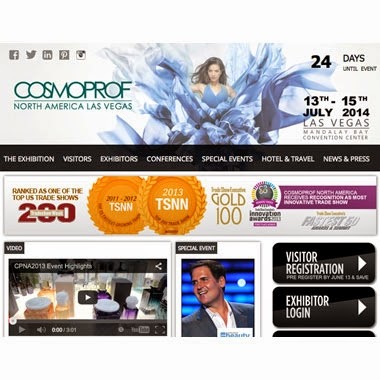
As you can see from the screenshot below, CosmoProf uses social media buttons for Facebook, Twitter, LinkedIn, Pinterest, and Instagram as designators to the platforms in which businesses and consumers may engage with CosmoProf before, during and after the conference. Although they have a presence on these platforms, their website is where they devote their time to truly promote the event. With one glance, one can see a countdown to the event, awards they've received for most innovative trade show, a YouTube clip of highlights from 2013 and quick click-through access to visitor registration.
CosmoProf North America Website Homepage
Their website is obviously their main hub of information. At the bottom of the page, the option to subscribe to a newsletter is available. I did not personally subscribe, so I could not attest to its role in the mix but it's possible that the newsletter's purpose was to drive traffic back to their website rather than to any particular social channel for guests to gather information before, during, and after the event.

To be honest, I expected to see more posts building anticipation for the trade show, but there was only one mention of the event on Facebook before opening on July 13th. However, once the event had started, both Facebook and Twitter were predominantly used to highlight certain booths and speaking engagements throughout the three day period. 

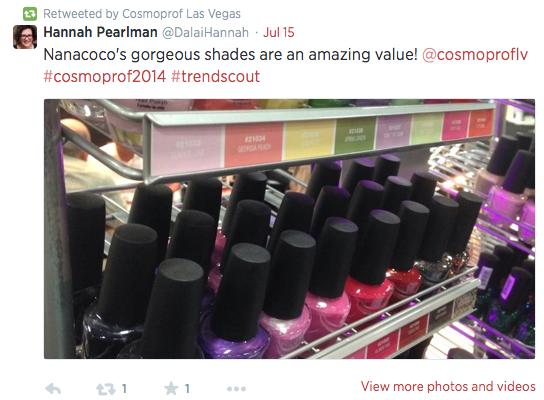
Facebook posts frequently included photos of new products. Twitter didn't include very many photos, but did retweet a very active user named Hannah Perlman (@DalaiHannah), who strategically used #trendscout and #cosmoprof2014 in her posts. As expected, Twitter gained the most response from visitors as they commented in real-time on their participation and experience. They mentioned brands and products with which they interacted and liked. 

Instagram was also very popular although it was mostly used for consumer-generated content. There are several web viewers that contain photos from the event--Websta and Iconosquare, to name a few--but any archived content had to be tagged with #cosmoprof in order to be viewed.

#cosmoprof Instagram submissions found on Iconosquare
It should be noted that there was not a unique official hashtag for the event, and the hashtags that were used were inconsistent. With hundreds of visitors using unofficial or other interest group-specific hashtags, this may affect any measurable data for future access and that which is reported back to sponsors.

For the most part, branding is consistent among channels. I was able to recognize very quickly whether I had landed on the verified account handles simply by seeing the model in a bright blue, windblown dress as pictured from their homepage. What stood out to me was their use of 10times, a service provider for business events. There are tabs where visitors could add themselves as "Attending" the conference, get information regarding hotels in Las Vegas, or leave a review. Visitors could see which exhibitors and plan ahead. I hadn't previously been aware of this content community or how they were changing the way in which we discover and experience events such as CosmoProf's trade show.

Overall, CosmoProf is making an effort socially, but could improve their IMC by using all channels to build anticipation for the conference, asking followers questions about the event or which brands/products they tried, consistently using hashtags and using them across platforms, and encouraging visitors and exhibitors to use said hashtags. There is a lot of potential here, and I know a little planning on their behalf could make a huge difference.

Friday, June 27, 2014

Three's Company: An Analysis of Brands and their IMC

Whole Foods Market (WFM) is a leading natural and organic food store, with nearly 300 stores across North America and the United Kingdom. They have an integrated marketing approach as their social media strategy is built around their company website and additional platforms including Facebook, Twitter, Instagram, Google+, and Pinterest. WFM is often considered a role model for other brands after five years of having successfully executed their social media marketing plan.

They are successful for a number of reasons, but I'll list the four that I find most important:
1. Each social platform has its primary objective. For example, Twitter is primarily for customer service, questions, and requests. Meanwhile, Facebook is where WFM promotes products, engages and educates their customers. None of their platforms are neglected, as they see the value of each being used equally to build their brand image.

Whole Foods Market on Google+ pictured above;
WFM Facebook on lower left and WFM Twitter on lower right
2. WFM keeps messaging and imagery consistent across platforms, using the logo and a prepared food item in their photo covers (see right). Content is updated daily (almost hourly on Twitter) and they drive users mostly to their blog with links. Their hashtags include #WFMdish and #WFMwine, but are used sparingly.

3.  They prioritize the local component of each store. Community managers focus on being where the customers are. These individuals work to engage with customers on WFM's multiple platform accounts.

4. They believe customer engagement and conversation should occur as naturally as possible. They are good at social listening and are ready to apply new ideas from what they learn.

----------

It takes a lot for a company to admit struggling to determine ROI in their social media strategy. It speaks volumes, however, knowing they found a way to make an impact socially utilizing resources already available to them. That's exactly what The Home Depot did by creating the "social media store associate" position. This hybrid role is now three years old, and allows select staffers to be go-to experts and social media content creators two days a week. Through their use of Facebook, Twitter, Instagram, Google+, and Pinterest, they assist with media appearances on Home Depot's How-To Community, The Apron blog, the Garden Club and HomeDepot.com.

Everything is up to date as the platforms highlight Home Depot's current specials of "Red, White and Blue Savings," for the Fourth of July.  They're using this across all platforms, so the messaging and imagery is consistent. Similar to Whole Foods, The Home Depot pushes users through to their blog via links in Facebook and Twitter posts. Their hashtags, #SpringMadeSimple, #DIHWorkshop, and #StyleChallenge produce results on almost all platforms.

Home Depot Vine Video on Facebook


I was especially drawn to their visual platforms -- Vine, Pinterest and Instagram. On these platforms, users can find fun, vibrant videos, and lots of high resolution photos. But each channel has their distinct purpose. Vine is used as a quick educational/tutorial tool. Pinterest is aspirational with the best looking visual information, whereas their Instagram makes the user want to share in the experience. All in all, it's great to see Home Depot make the distinct move toward more visually focused platforms when consumer interest towards the ongoing trend of visual posts is increasing.


----------

"Unlike the majority of retailers that believe brand to fan engagement is the primary goal of social media, Amazon has always concentrated on personalizing the shopping experience," says Wade Gerten, CEO of 8thBridge, Inc. Out of the three brands I've researched, Amazon is the only one that is almost exclusively promotional on all of its social media platforms. They take an integrated approach, having a presence on Facebook, Twitter, Instagram, Google+, and LinkedIn. All of these channels are consistent in messaging and imagery as they currently advertise "the first smartphone designed by Amazon #firephone."

Facebook is the network with the most up to date content, with Instagram and Twitter in close second. Their newsfeed on Google+ is heavy with promotional information about electronics like headphones, watches, and other gadgets. Amazon's use (or lack thereof) of Pinterest was really surprising and saddening. As the photo below shows, they only maintain 18 boards - many of them old - and a little over 800 pins.

Amazon Pinterest header 

Besides #firephone (or any hashtag promoting a new product of theirs), their use of hashtags is inconsistent across platforms. Amazon doesn't drive users to their other social channels. Rather, any consumer interactions that happen on Facebook, Twitter, and Pinterest drive significant sales to its online retailer site to make a purchase.

Some would argue that Amazon has missed the boat on social media, but their incorporation of social elements into its own site cannot be overlooked. They make it easy for shoppers to share products with their friends with a Like button, Tweet button, Pinterest Pin-it button, Google+1 button, and an Email A Friend button on its product pages. Additionally, Amazon gives customers with Facebook-connected accounts to see reviews written by their Facebook connections. By use of crowd sourcing, Amazon is making efforts to personalize the consumer's shopping experience.


Sources:
Schoultz, M. (No Date). "How Whole Foods Marketing Uses Social Media to be a Difference Maker." Digital Sparks Marketing. Retrieved 26 June 2014.
http://www.digitalsparkmarketing.com/creative-marketing/social-media/whole-foods-marketing/

Stambor, Zak. 5 Dec 2013. "How Social is Amazon?" Internet Retailer: Portal to E-Commerce Intelligence. Retrieved 26 June 2014.
http://www.internetretailer.com/2013/12/05/how-social-amazon

Zmuda, Natalie. 29 Sept 2011. "Home Depot's Social Media Strategy Pays Off." Advertising Age. Retrieved 26 June 2014.
http://adage.com/article/special-report-social-media-guide/home-depot-s-social-media-strategy-pays/229865/

Friday, June 6, 2014

Swamp Head Brewery - Website Analysis

To follow up on my post from last week, I'm analyzing Swamp Head's website and how they incorporate brand consistency within this particular platform.


I find their website has leveraged a nice blend of push and pull marketing techniques. While on their homepage (and with minimal clicks), you are able to access their list of beers, get information about the brewery and find the latest posts to their company blog, "Swamplog."

There is obviously a lot of push happening on the website. The amount of information you can derive is almost overwhelming. An example of how the website allows push and pull to happen simultaneously can be found on their list of brews in the tasting room. The consumer gets multiple things at once - displayed information about the products and pricing (push). Meanwhile, the map in the corner, operating hours and address provides the information the consumer needs in deciding whether to make the trip to the brewery (pull). Combining push and pull in this way "reinforces key branding and retailer objectives" (S2 Customer Insight Blog).

It's interesting how they also use the site as a touchpoint for e-commerce. On the same page as their brew list, you can find out about purchasing Swamp Head merchandise like t-shirts and hats.

The content on the website is fresh. It lists their latest blog posts and upcoming Swamp Head events they'll be attending, sponsoring, and serving their craft beer. Within their blog content, they include share buttons, but an RSS feed option is not available. This leads me to believe that their blog updates are not as consistent as they are on other social media channels. They include outbound links, but there is a lack of categories and labels being used to assist in finding similar posts in their archive. With a quick Google search, I did find a Wordpress blog by the same name, but the content on the Wordpress blog was inconsistent to the Swamplog that's made available on their website (the last post was in March). Although there is a follow button available, no categories or labels are used. This explains why the Wordpress blog was found on page two of the Google search. A little help with keywords in either blogging platform could fine-tune SEO and help them show up for the right search terms. Since blogs are a great tool for pull marketing, I would especially like to see them improve in this area.

I was initially concerned about how mobile-friendly the website would be because of all the information that is packed on the full site. Luckily, the mobile site is very user-friendly. It allows for easy navigation, integrating scrolling features and swiping options throughout (see photos below). There were more photos than text which is always helpful with shorter attention spans, and they provided easily-digested answers to consumers' questions. You can access all of the same information and social buttons as you could on the full-site, too. 


One feature I touched on in my previous post, is Swamp Head's brand consistency throughout their design and social media content. According to the Brand Consistency for Website Navigation, Social Media and SEO slideshare, incorporating brand consistency means they're working toward an honest identity and being consistent with that identity. The desire for consistency in customer service, product quality and marketing practices is apparent from the owner, Luke Kemper, in this interview where he attributes success to "running a business that is ethical." He says, "...[when you] treat people fairly and try to do the right thing, people notice." His mindset and passion for brewing a high quality beer set the tone and personality that comes across in the brand on their website and other platforms. 

If there's anything that I learned from this analysis it's that no matter how great their social media engagement is, Swamp Head still has areas that can be improved upon. Its push and pull marketing techniques help visitors find valuable content on their website and contribute to their branding. Their website's navigation, consistency in information across its blog(s) and website, and SEO keywords could all be fine-tuned to make them more visible in the right places. 


Sources:
S2 Customer Insight Blog: Push and Pull Maketing (graphic). (n.d.). S2 Customer Insight Blog. http://s2customerinsight.com/blog/push-and-pull-marketing/

Brand Consistency for Website Navigation, Social Media and SEO. (2011, July 26). Brand Consistency for Website Navigation, Social Media and SEO.  http://www.slideshare.net/lizhenderlong/brand-consistency-for-website-navigation-social-media-and-seo


Richardson, W. (2013, March 19). Luke Kemper - All About Beer. All About Beer. http://allaboutbeer.com/luke-kemper/


Friday, May 30, 2014

Swamp Head Brewery's "got 99 problems, but good beer ain't one."


Swamp Head Brewery was founded in 2008 and prides itself on being Inherently Floridian. They started up in Gainesville, and make their love for Florida apparent in their logo, brand, and mission to be "Florida's brewery." The short bio description I used in the blog post title was found on Swamp Head Brewery’s twitter page. I love it because it's a great attention-grabber for those who have never been exposed to the brand - it shows a little attitude, helps tell their story, and includes a reason for people to follow their account. This is just one example of how I find them to be successful in using multimedia communications to reach their customers.

The three things that I really appreciate about Swamp Head Brewery are how they focus on telling their story, they work to keep fans up to date on their social media platforms, and focus their energy on the local Gainesville community. Their website not only shares their story, staff and upcoming events, but also includes ongoing promotions, tasting room selections, and photos (posted by company AND customers). They've realized that is a starting point to inform the consumer and they immediately make it known that the company can be followed on social media with one-click widgets on their homepage (see below). 


In terms of social media, Swamp Head creates lots of opportunity for dialogue and the tone and voice of their messaging highlights their passion for the brewery and its products. You cannot mistake having reached their company/business pages because they use the cover photo function to keep their pages consistent with their website. They often use the platforms to promote new products and share across platforms by linking to their social media accounts within posts. This makes it very easy for people to follow them on their preferred platform (or all of them).  


Swamp Head understands the importance of making sure posts show up in people’s feeds, letting people get involved in their story and communicating with them one-on-one.  They share great content like pictures and videos from the Brewery, messages about brewing beer, notifications about events (on and off premise), and local community events that they’re involved in. The 5th Annual Taste of Gainesville post below showcases their official beer sponsorship. 

Swamp Head's marketing department is obviously doing their job very, very well. Not only has the company expanded to selling merchandise like t-shirts, hats, and frisbees, but you can find their craft brews served in bars and restaurants across the state of Florida. They are doing so well for themselves in fact, that they are looking to relocate and double in size. A lot of this has to deal with Swamp Head's online presence via social media platforms, as it's consistent with their goals and brand. Their approach is interactive and entertaining,  and they understand "it takes a village" and its involvement to get their brand recognized as Florida's brewery.


Sunday, May 25, 2014

Direction of Communication and Scope

Direction of Communication
In discussing the aspect of direction of communication, classic marketing is unidirectional. This means information and brand awareness is spread actively from the company to a passive audience. I would say classic marketing was appropriate when the messages highlighted the most commonly demanded goods to the largest common denominator of consumers via mass media like TV, radio, newspaper, and billboards. Marketers targeted specific demographics and reached a large audience in doing so. To rely solely on unidirectional marketing in this day and age, though, would be a marketing fail.
 
On the other hand, the new, social way of marketing can expect the best benefits of promotion and exchange of dialogue. Both the company and customers actively talk and listen to one another. There is a plethora of pros to social marketing, but here are two I deem most important:
1. It's where the brand's consumers are - the average person spends at least 23 minutes per day on Facebook, giving the brand optimized ad placement based on their preferences and psychographics.
2. Social media presents an opportunity for a degree of personalization, thus creating involvement and relevance, not just awareness (See Mass Marketing vs. Personalization infographic here on Social Media Today).


Campaigns have proven to be more effective when they include multimedia and multi-channels. With participatory channels, influence becomes more powerful than reach (Young, 2010). Classic marketing is better than social when traditional marketing channels are able to create especially memorable and emotional occasions with a brand and integrate tools of social media to create dialogue. This works well because it has the potential to lead to viral marketing. Direction of communication refers to social marketing channels like Facebook and Twitter where consumers spend most of their time and are prone to sharing "likes" of particular brands, organizations, and customer service experiences with their network of friends and fans. 
 
Scope
Classic marketing and social media marketing both want to gain market share for a product or service. The classic approach is smaller in scope, only because the bigger the audience you want to reach, the more it costs. Classic marketing allows for delivering to large audiences, measured by demographics that advertisers bought. This is noted with the product or service sale, but engagement ends there. In this way, I believe classic to be better than social.
 
Social is accessible by anyone regardless of their location. The downfall is you lose targeting. According to the reading from Mitch Joel's The World is Changing has Changed, the average post from a Facebook brand page only reaches 16% of its fans. So trying to reach a certain demographic may prove to be difficult.
 
A social media marketing campaign can be just as successful as its classic counterpart if it has knowledge of demographics from their users. Without it, there's only opportunity for the brand to target by content behavior and response (Young, 2010). Social marketing allows for more interaction with the brand since the consumer is digitally-enabled and connected. The consumers' appetite for information and entertainment grows exponentially, as the focus now shifts from markets and products to the brand's customers, their relationships and interaction over time. Although sharing an opinion of the product or service becomes as easy as a like or re-tweet button, the social model demands much more than what's normally included in marketing.
 
A brand's marketing campaign will retain its competitive edge by raising awareness via classic marketing and then engaging their audience through their social media platforms.
 
Source:
Bennett, S. (2013, December 1). Facebook Vs Twitter: Revenue, Users, Average Time Spent, Key Mobile Data [STATS]. - AllTwitter.
http://www.mediabistro.com/alltwitter/facebook-vs-twitter-data-stats_b51335

Jones, M. (2013, May 13). Mass Marketing vs One-to-One Personalization [INFOGRAPHIC]. RSS.
http://socialmediatoday.com/martinjones/1452891/mass-marketing-vs-one-one-personalization-infographic

Stone, J. J. (2014, February 26). Social Media vs. Classic Marketing - We teach you how to start your own business in 60 days. We teach you how to start your own business in 60 days.
http://60daymba.com/social-media-vs-classic-marketing/

Young, A. (2010). Brand Media Strategy: Integrated Communications Planning in the Digital Era. New York: Palgrave Macmillan.